

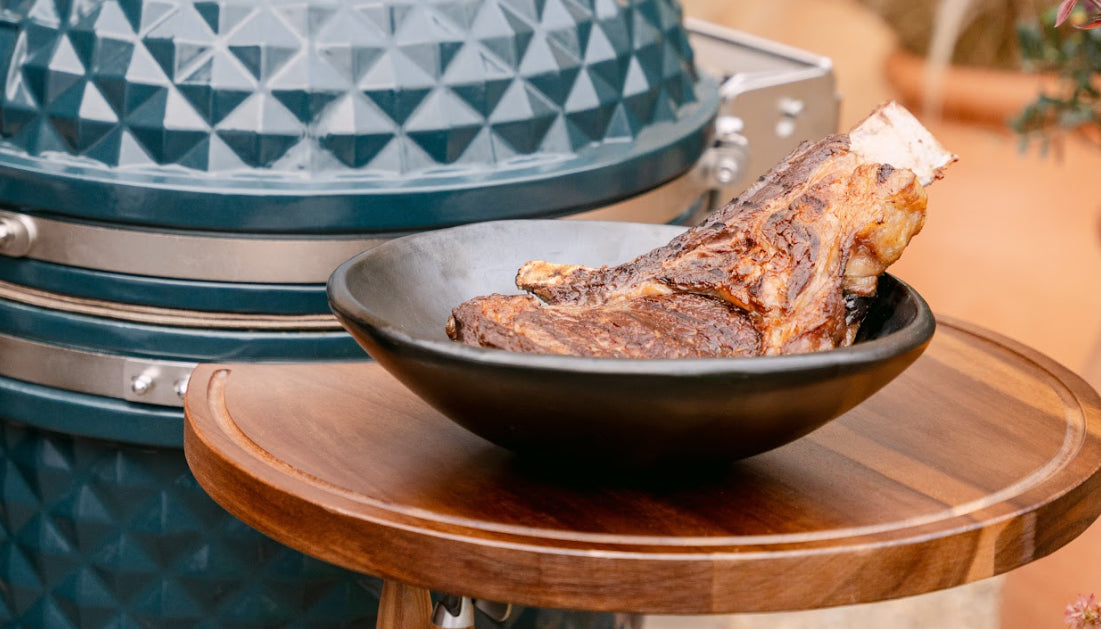
Cooking rib of beef on the barbecue is a true art form that deserves special attention. A quality rib of beef is first recognised by its marbling—those fine streaks of fat that guarantee exceptional tenderness and flavour.
To achieve a perfectly cooked cut, it’s essential to master not only the cooking techniques but also the preparation of the meat.
A rib of beef that has been aged for at least 3 to 4 weeks will develop more complex flavours and unrivalled tenderness. Temperature is also crucial—for perfect cooking, it’s best to use a probe thermometer to check the core temperature:

Whether you opt for a 800g cut for 4 to 6 people or a larger 1.2 kg piece, this guide will walk you through the foolproof recipe for kamado barbecue rib of beef.
Choosing the right rib of beef for the barbecue

To master the art of grilling a rib of beef on the barbecue, choosing the right meat is a crucial first step. Several criteria will help you select a quality cut that promises an exceptional taste experience.
How much meat to plan for your number of guests
Rib of beef is typically a generous cut, perfect for a convivial meal.
| Meat quantity (bone included) | Light eaters | Hearty eaters |
| 250g-300g | 2 people | 1 person |
| 700g-800g | 5 people | 3 people |
| 1kg | 6 people | 4 people |
For an adult, allow between 250 and 350 grams of meat on the bone. So, a rib of beef weighing around 1 kg is ideal for 4 to 5 people.
Don’t hesitate to ask your butcher for advice; they can adjust the weight to suit your guests’ appetites.
How to identify well-marbled meat
Marbling, those fine streaks of fat within the muscle, plays a key role in the flavour and quality of the meat. A well-marbled rib of beef will be juicier, more tender, and more flavourful. To spot it, look closely at the white marbling running through the red meat. The denser the marbling, the better the tasting experience. Choose bright red meat with a firm texture to the touch.
The cuts particularly renowned for their marbling are:
- Aubrac
- Charolais
- Limousin
- Angus
The importance of beef aging
Aging is an essential process that transforms muscle into meat. A ribeye that has been aged for at least 3 to 4 weeks will develop more complex flavors and exceptional tenderness. This natural process takes place in a chamber kept between 1° and 3°C with controlled humidity. During aging, two phenomena occur:
- Proteolysis, which breaks down proteins and tenderizes the meat,
- Lipolysis, which develops the aromas.
This process also explains why dry-aged meats are more expensive, as they can lose up to 30% of their weight in water.
Ideal butcher’s cut thickness for perfect grilling
The thickness of the ribeye directly affects the success of your grilling. For a barbecue, choose a thick cut, between 4 and 8 cm. This thickness allows you to perfectly sear the outside while keeping the center juicy and flavorful, according to your preferred doneness.
Prepare the meat before cooking
Preparing a ribeye before grilling is a fundamental step to ensure a delicious result. A few simple yet essential actions will enhance the natural quality of the meat and optimize its cooking.
Bring the meat to room temperature
Before cooking, it is essential to take the ribeye out of the refrigerator. This often-overlooked step prevents thermal shock, which can make the meat less tender. According to experts, the ideal resting time is between 30 minutes and 1 hour before cooking. For particularly thick cuts, some butchers even recommend up to 2 hours at room temperature. This waiting period ensures more even cooking and preserves the tenderness of the meat by preventing it from toughening when exposed to heat.
Simply season: salt, pepper, oil
When it comes to seasoning, simplicity is key to preserving the natural flavors of the meat. Salt is essential, but always add it after cooking.
Never salt red meat before cooking to prevent it from toughening.
For pepper, the same applies: add it after cooking to avoid bitterness.
Additionally, lightly brushing olive oil over all sides of the meat helps achieve better caramelization. For those seeking more flavor, a simple marinade with aromatic herbs like thyme and rosemary is a great option.
Use the right utensils (tongs, probe, oiled grill)
Choosing the right utensils is key to a successful rib of beef on the barbecue. Opt for tongs to handle the meat rather than a fork. Piercing the meat would cause it to lose its juices, making it dry and less flavorful.
Using a temperature probe is also a major advantage for perfectly mastering the internal doneness.
It should be positioned in the center of the meat, inserted from the side of the cut. The ideal core temperature for a rib of beef is 55°C.
Finally, remember to lightly oil your barbecue grill before placing the meat on it to prevent sticking and make handling easier.
Direct vs indirect cooking: when and how to use each method
Direct cooking means placing the meat directly on the grill above the coals, ideal for quickly searing the outside.
Indirect cooking, where the meat is placed on a heat deflector, is best suited for thick cuts.
For a rib of beef, start with a direct cook for 2-3 minutes on each side to create a beautifully seared crust, then switch to indirect cooking to finish gently.
This method ensures meat that is crispy on the outside and melt-in-the-mouth on the inside.
Cooking time by weight (1 kg, 2 kg, etc.)
| Rib weight | Slice thickness | Cooking time (rare) |
| 500g | 3cm | 12min |
| 500g | 4cm | 16min |
| 1kg | 3cm | 24min |
| 1.2kg | 3cm | 28min |
For perfect cooking, allow about 12 minutes per pound (500g) of meat for a rare ribeye. So, a 1 kg piece will need about 24 minutes in total. For a 1.2 kg ribeye, plan between 25 and 35 minutes depending on your preferred doneness. Remember, time also varies with thickness: for a 3 cm thick cut, allow 12 minutes in total, versus 16 minutes for 4 cm thickness.
Core temperatures for each doneness level
Use a meat thermometer for precise results:
- Blue: 45-50°C
- Rare: 50-55°C
- Medium: 55-60°C
- Well done: 62-70°C
Pro tip: To avoid overcooking, remove the meat 8-10°C before your target temperature, as it will continue to cook while resting.
Finish with a flavored butter at the end of cooking
To elevate your ribeye, prepare a herb-infused butter with fresh herbs:
- 100g softened butter
- a bunch of fresh herbs (parsley, chives, thyme)
- a squeeze of lemon juice
- a pinch of salt
Mix the ingredients and chill for 30 minutes before using. Some chefs even suggest variations with Roquefort and walnuts or sun-dried tomatoes and Espelette pepper.
Place a small knob of this butter on the hot meat just before serving for an explosion of flavor.

Resting meat after cooking
The step that follows perfectly grilling a ribeye on the barbecue is often overlooked, yet it is crucial for the final quality of your meat.
Resting and proper slicing turn a simple ribeye into a true culinary masterpiece.
Why let meat rest
After removing your ribeye from the barbecue, it is essential to let it rest in a warm place. This crucial step allows the temperature to even out and the meat to relax.
During cooking, the heat causes the muscle fibers to contract, pushing moisture to the center of the meat. Resting allows the muscle fibers to gradually relax.
For a ribeye steak, experts recommend that the ideal resting time should be between 20 and 25% of the total cooking time. So, for 100 minutes of cooking, allow about 20 minutes for resting.
To keep the steak warm without continuing to cook it, you can loosely wrap your ribeye in aluminum foil, without sealing it tightly. Ideally, place it on a rack to allow optimal air circulation.
How to carve a ribeye steak
To carve your perfectly rested ribeye steak, use a long, sharp carving knife and a large cutting board.
Carving is done in three main steps:
- Separate the meat from the bone by standing the steak upright and making a precise cut along the bone. Gently follow the curve of the bone to fully detach the meat.
- Trim off excess fat to your liking,
- Slice the meat into thick pieces about 2 centimeters, slightly on the bias. To preserve all the juiciness, use a smooth back-and-forth motion.
- Key point: never pierce the meat with a fork while carving. The fork should only hold the steak in place, lying flat.
Side dish ideas for your kamado-grilled ribeye steak

A beautiful ribeye steak grilled on the kamado deserves sides worthy of it to create a truly memorable meal. The choice of garnishes and final seasonings elevates the exceptional flavor of this cut.
Simple and delicious side dish ideas
Classic sides perfectly enhance the rich flavors of ribeye steak. Among the most popular options, potatoes come in many forms: wrapped in foil with a drizzle of olive oil and fresh herbs, oven-roasted wedges with rosemary, or finely diced with garlic. These starches ideally absorb the meat’s juices.
To bring freshness and lightness, grilled vegetables are an excellent choice. Eggplants, zucchini, and peppers sliced, brushed with olive oil, and cooked directly on the kamado grill develop smoky flavors that pair perfectly with the meat.
A simple green salad dressed with a tangy vinaigrette also offers a refreshing contrast.
Click right here to discover a variety of mushroom recipes to pair with your beef cut—you won't be disappointed. Tips and explanations on the benefits of mushrooms, your ally for a gourmet experience and to impress your guests:
Barbecued mushrooms: tips & recipes
Final seasoning: fleur de sel, pepper, herbs
The final seasoning of your côte de bœuf is the ultimate touch that will elevate your tasting experience. First, choose fleur de sel, whose crunchy crystals bring a delicate salinity and an appealing texture on the palate. Lightly sprinkle it over the sliced meat just before serving.
Freshly ground pepper, ideally black peppercorns crushed in a mortar, reveals far more complex aromas than pre-ground powder. A coarse grind preserves all its fragrance and offers a pleasant textural contrast.
Finally, fresh herbs add an extra aromatic dimension. Thyme, rosemary, and sage can be used during cooking, while finely chopped flat-leaf parsley, chives, or tarragon are sprinkled over the meat when serving. For a bolder touch, herb and garlic butter placed on the hot meat creates an instant sauce bursting with flavor.
Conclusion: Mastering côte de bœuf on the barbecue – the keys to perfect grilling
From choosing a well-marbled cut to the two-stage cooking (direct then indirect), every step shapes the final result. Meat at room temperature, a beautifully caramelized crust, a juicy center, and a proper resting time: these are the secrets to a côte de bœuf that's tender and full of flavor.
Add a seasonal side and turn your barbecue into a true moment of sharing. With these tips, mastering your côte de bœuf on the barbecue becomes an art within everyone's reach.


