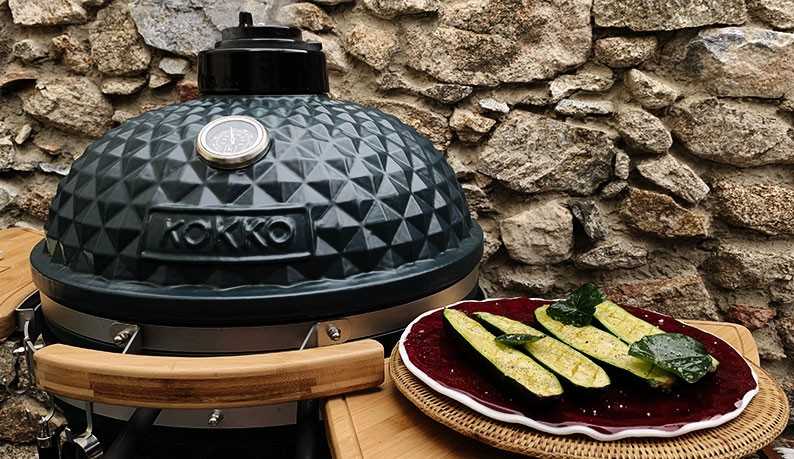
What is indirect cooking?
With direct cooking, food is placed directly above the coals. This method allows you to sear and cook food quickly. In contrast, indirect cooking is not about grilling, but roasting food as you would in an oven. This technique is performed with the barbecue lid closed and without direct contact between the food and the heat source. Indirect cooking ensures even heat distribution inside the barbecue, so your food won’t burn, cooks evenly, stays juicy, and retains all its flavour. The heat circulates just like in a fan oven. For certain foods, this method is preferable if you want the best taste and nutritional results.
What should you cook with indirect heat?
It is best to choose indirect cooking for foods that require a longer cooking time, that is to say, more than 30 minutes. This method is particularly suitable for thick cuts of meat (over 5 cm thick), whole pieces, or delicate foods such as certain whole fish, fillets, or skewers. It ensures even cooking throughout the food. It is ideal for poultry—see our tips for perfectly roasting a whole chicken on the BBQ—duck breast, vegetables, or cuts you want to enjoy meltingly tender, such as leg of lamb, turkey leg, brisket, or pork belly, which require slow, gentle cooking.

Discover Jacky’s beef short rib recipe, a barbecue enthusiast and above all, a Kokko lover!
And with direct cooking?
Direct cooking is perfect for foods that don’t require long cooking times, that is, less than 30 minutes. It is suitable for all types of sausages, chipolatas, merguez, andouillettes, skewers, escalopes, chops, cutlets, and burgers. Even when the cooking time is short, direct cooking is mainly suited to foods that are “robust” enough, such as the meat cuts mentioned or certain vegetables like grilled peppers. As for seafood, shellfish (prawns, lobster, king prawns, etc.) and certain fish such as sea bream, sardines, or bass are also ideal for direct cooking, as they only need a few minutes on the grill. Our tips for perfect fish on the barbecue and for cooking seafood on the barbecue.
Keys to successful indirect cooking with Kokko
With a classic charcoal barbecue, you can achieve indirect cooking by moving the coals to one side and cooking your food on the other. But the Kamado, with its lid, is the ideal barbecue for indirect cooking.
With a Kokko, it couldn’t be easier. Simply place a heat deflector inside the barbecue. There are two types: the lava stone and the ceramic stone, both of which act as a barrier to the flames and coals, absorbing the heat before diffusing it evenly to the food above. The ceramic stone is also the must-have accessory for making pizzas on your Kokko.
What’s more, you can cook different types of food at the same time in your Kokko thanks to the stainless steel half-grate and the cast iron half-grate placed on one side of the chamber, and the half plate for indirect cooking on the other. This half plate is perfect for indirect cooking of delicate foods such as vegetables, fish, or seafood.
In addition, with this poultry roasting rack you can also achieve indirect cooking on your Kokko and enjoy tender poultry that retains all its juices and flavour in the dish.
Our recipe ideas for indirect cooking with Kokko:
Discover another barbecue cooking method: smoking. Find out how to smoke your food with Kokko.


