

A homemade smoked salmon recipe offers a flavour experience unlike anything mass-produced supermarket versions can deliver. Delicately flavoured with a melt-in-the-mouth texture, smoked salmon prepared at home soon becomes a culinary achievement to share with pleasure.
In fact, preparing smoked salmon is not as complicated as you might think. From the salting time and the choice of salmon to the smoking itself, every step is within reach of the home cook. This guide covers the entire process: selecting the ingredients, the equipment needed (particularly the versatile and precise Kamado Kokko salmon smoker), and the techniques for achieving perfectly balanced homemade smoked salmon. Kokko smoking accessories also help optimise the results, turning a simple recipe into a culinary masterpiece. Whether you are new to smoking salmon or already experienced, this step-by-step guide will help you achieve excellent results.
Essential equipment for smoking salmon
The right equipment is essential for a successful homemade smoked salmon recipe. It can turn a simple culinary experiment into a gastronomic success. Here are the essential tools for mastering the art of smoking salmon.
Smoking with the Kamado Kokko
The Kamado Kokko is a revelation for smoking enthusiasts. Inspired by traditional Japanese techniques, this salmon smoker has a ceramic structure that maintains a constant temperature, essential for successful smoking. Unlike traditional smokers, the Kamado Kokko offers remarkable versatility.
Its innovative design allows precise temperature control between 70°C and 400°C, making it ideal for smoking salmon, which requires gentle, sustained heat. Its dual ventilation system also ensures optimal smoke circulation around the fish, allowing the flavours to develop evenly.
The Kamado Kokko's thermal insulation is also a major advantage. It maintains a stable temperature for several hours while using less fuel. This is crucial when preparing smoked salmon, which often requires a long smoking time.
Recommended Kokko smoking accessories

To make the most of your Kokko kamado’s capabilities, certain dedicated accessories are essential:
- Cold-smoking coil - Ideal for cold-smoking salmon, this stainless steel coil produces a fine, steady smoke for tender salmon with a delicate aroma. Optimises airflow and makes cleaning your Kokko easier.
- Smoke generator tube - Perfect for hot-smoking salmon, it produces an even smoke and lets you add wood chips without opening the lid, preserving the temperature and aromas.
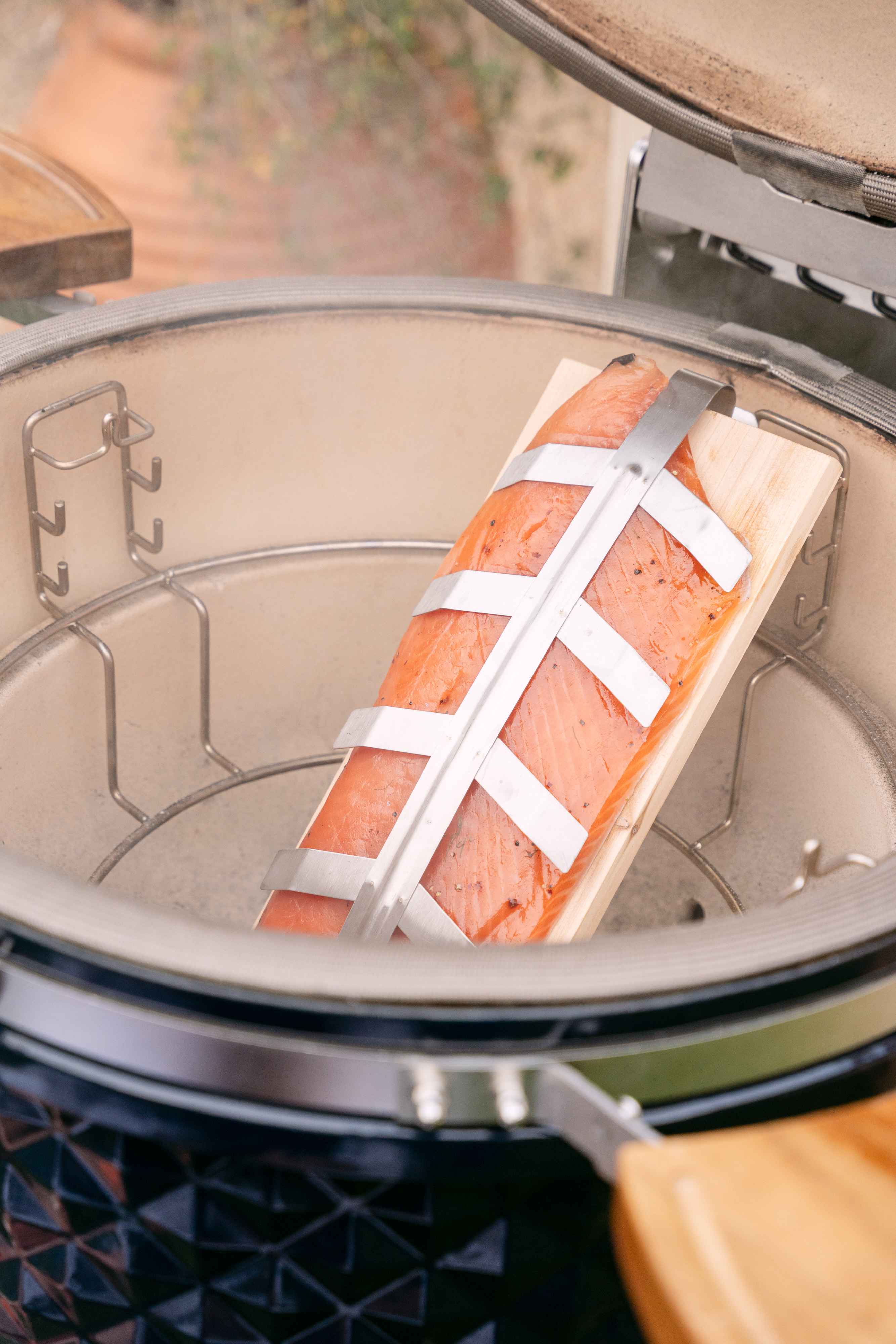
- The salmon smoking plank - Made from natural wood, it holds the salmon in the ideal position for even exposure to smoke.
Together, these Kokko smoking accessories turn what could be a complex process into a controlled experience, even for those new to smoking salmon.
Thermometer, cooking grates, wood chips
The thermometer is perhaps the most important tool after the smoker itself. A connected probe thermometer with remote readings lets you monitor the temperature without opening the kamado, avoiding harmful temperature fluctuations. For homemade smoked salmon, maintaining a temperature between 65°C and 85°C is ideal.
For the cooking grates, choose stainless steel, which resists corrosion and high temperatures. Fish-specific grates with non-stick surfaces make it much easier to handle salmon without damaging it.
Wood chips play a decisive role in the final flavour profile:

- Beech: Produces a light, subtle smoke, perfect for salmon
- Maple: Adds gently sweet notes
- Cherrywood: Adds a delicate fruity note
- Applewood: Gives a slightly sweet, fruity aroma
Soaking the wood chips for around 30 minutes before use is recommended to make them burn longer and produce denser smoke. However, this step is optional with the Kokko kamado, whose optimised ventilation system already provides excellent control over combustion.
The right salting time for salmon before smoking matters as much as the equipment you use. Even the best preparation, however, cannot deliver optimal results without the right tools. Investing in quality equipment such as the Kokko kamado and its specialist accessories is therefore the first step towards successfully smoked salmon.
Preparing salmon: the essential steps
Preparing the fish is the foundation of successful smoking. The perfect homemade smoked salmon begins long before the smoker is lit, with the choice of fish. Every step matters and directly affects the final quality.
Choosing quality salmon
The quality of homemade smoked salmon depends above all on the quality of the raw fish. For the best results, choose fresh salmon rather than frozen. Here are the key signs of good salmon:
- Firm, springy flesh that returns to shape after gentle pressure
- An even pink-orange colour with no brown or grey areas
- A fresh, ocean-like smell with no hint of ammonia
- Prominent, bright eyes if buying a whole fish
- Shiny, firmly attached scales
Wild salmon generally has more flavourful, less fatty flesh than farmed salmon. However, some responsibly run fish farms produce excellent salmon. For freshness, buy from a trusted fishmonger who can advise you on its origin.
Fillets weighing around 1 to 1.5 kg are also ideal for a first attempt at smoking. This size makes them easy to handle, particularly on the specially designed racks of the Kokko kamado, which optimise smoke circulation around the fish.
Removing pin bones and cutting
Once you have selected your salmon, removing the pin bones is essential. Bones can spoil the eating experience and must be carefully removed before smoking the salmon.
To remove the pin bones effectively, place the fillet skin-side down on the work surface. Gently run your fingers over the entire surface to locate the bones. Use fish bone tweezers or tweezers reserved for culinary use to pull out each bone in the direction it lies. This careful method prevents the flesh from tearing.
For cutting, you have two options:
Firstly, you can work with whole fillets, which are particularly well suited to Kokko smoking accessories that hold the fish in the ideal position throughout the smoking process.
Secondly, to make larger salmon fillets easier to smoke, cut the fillet into even portions of approximately 300 to 400 grams. This ensures the salt penetrates evenly during salting before smoking, as well as even exposure to smoke.
For perfect slices after smoking, cut across the grain of the fish using a sharp, slightly damp knife.
Cleaning and shaping
Before salting, thoroughly cleaning the salmon is an essential step. Rinse the fish carefully in cold water to remove any scales and impurities. Then gently pat it dry with kitchen paper.
Shaping the fish helps maximise its exposure to smoke and makes it easier to handle later. Remove the thinner belly section (also known as the "belly flap"), which would cook too quickly in the salmon smoker. You can set it aside to cook separately or serve it as tartare.
If you are preparing a whole fillet, even out its thickness by trimming the edges slightly to give it a rectangular shape. This helps the salt and smoke penetrate evenly.
Next, check that all pieces of dark skin (known as "melanin") have been removed, as they can give the finished product a bitter taste. Inspect the fish carefully in good light to spot them.
To make the fillets easier to handle when smoking them in your Kokko Kamado, you can place them on baking parchment or use the special fish supports available among Kokko's smoking accessories. These supports hold the salmon in the ideal position, allowing smoke to circulate evenly around the fish.
At this stage, your salmon is ready for the next step: salting, which is essential to making homemade smoked salmon. Careful preparation provides a sound foundation for the entire smoking process.
Salting salmon: techniques and timings
Salting is the decisive step that turns a simple salmon fillet into the perfect foundation for smoking. This crucial stage in making homemade smoked salmon directly affects the texture, shelf life and, of course, the final flavour. Mastering salting techniques is therefore essential for anyone who enjoys making smoked salmon.
How long to salt salmon before smoking
The ideal salting time depends mainly on the thickness of the fillet. For successful homemade smoked salmon, follow these timings:
- For a thin fillet (under 2 cm): 12 to 16 hours of salting are sufficient
- For a medium-thickness fillet (2-3 cm): 18 to 24 hours are needed
- For a thick fillet (over 3 cm): 24 to 36 hours ensure optimal salt penetration
Salting for too short a time limits how long the salmon will keep and leaves its flavour underdeveloped. Conversely, excessive salting makes it too dry and too salty. When using the Kokko kamado, timing matters: this salmon smoker brings out the subtleties of properly salted fish.
Temperature is also crucial. Salting must take place in the fridge at between 2°C and 4°C to prevent bacterial growth. Kokko smoking accessories, such as specialist trays, also make it easier to transfer the salmon directly from the fridge to the smoker with minimal handling.
Dry salting vs brining
There are two main methods for preparing smoked salmon: dry salting and brining. Each has distinct advantages.
Dry salting involves coating the fillet directly with a mixture of salt and, optionally, sugar. This traditional technique draws out more moisture, making it ideal for smoking salmon in the Kokko kamado, whose precise temperature control preserves the resulting texture. For dry salting, allow approximately 65 to 80 g of salt per 1 kg of salmon. Apply the mixture evenly to every surface of the fish, then wrap it in cling film before placing it in the fridge.
By contrast, brining completely immerses the salmon in a saltwater solution. This method distributes the salt more evenly and better preserves the fish’s natural moisture. To prepare an effective brine, dissolve 100 to 120 g of salt in 1 litre of cold water. Then immerse the salmon for the time appropriate to its thickness.
Nevertheless, whichever method you choose, it is essential to rinse the salmon thoroughly under cold water after salting to remove excess salt from the surface. This often-overlooked step prevents the salmon from becoming too salty when smoked in your Kokko kamado.
Spices and herbs to add
Adding spices and herbs during salting lets you personalise your homemade smoked salmon. These aromatics gently infuse the flesh while the salmon salts before smoking. Here are some particularly successful combinations:
- Nordic classic: crushed juniper berries, chopped fresh dill, lemon zest and white pepper
- Bold aromatics: wild fennel, coriander, star anise and pink peppercorns
- Sweet notes: brown sugar, orange zest, cardamom and vanilla
- Asian fusion: grated ginger, lemongrass, makrut lime and a dash of soy sauce
To incorporate these flavours, add them directly to the salt mixture for dry salting or to the liquid brine. The ideal proportion is approximately 10% herbs and spices by weight of salt.
Once the salmon has been properly salted, it is ready for drying, followed by smoking in your Kokko kamado. Kokko smoking accessories, such as the heat deflector, then help you control the circulation of smoke precisely around the salted fish, ensuring optimal absorption of the wood aromas. Attention to detail from the salting stage is the foundation of exceptional homemade smoked salmon.
Drying salmon: why it is essential
After salting, drying is a crucial step in preparing homemade smoked salmon. Often overlooked by beginners, it has a significant effect on the final quality. Drying allows the salmon to develop the characteristic glossy coating known as the "pellicle", which helps the smoke adhere.
Refrigerator drying method
Drying in the refrigerator is the most accessible and safest way to prepare your salmon before smoking. After rinsing and gently drying the salted fish, place it skin-side down on a raised rack. This allows air to circulate freely around the entire fillet.
Then place everything at the bottom of the refrigerator, at a constant temperature between 2°C and 4°C. One essential point: do not cover the salmon during this stage. Exposure to the cool, dry air in the refrigerator encourages moisture on the surface to evaporate gradually.
For Kamado Kokko users, dedicated smoking accessories make this step much easier. In particular, special salmon racks hold the fish in the ideal position throughout drying, then allow you to transfer it directly to the smoker without excessive handling that could damage the valuable pellicle that has formed.
Ideal drying time
The drying time depends mainly on the thickness of the fillet and how thoroughly you want to dry it. As a general guide, allow:
- 6 to 8 hours for a thin fillet (under 2 cm)
- 12 to 18 hours for a medium-thickness fillet (2-3 cm)
- 18 to 24 hours for a thick fillet (over 3 cm)
The salmon is ready when its surface becomes slightly glossy and tacky (sticky to the touch). This indicates that the protective pellicle essential for smoking salmon has formed.
A simple test will also tell you whether the salmon has dried sufficiently: gently touch the surface of the fish with your finger. If it leaves a slight indentation that quickly disappears, the drying is just right. If the flesh still feels moist or your finger sinks in too easily, dry it for a few more hours.
Effect on the final flavour
Drying has a considerable effect on the sensory qualities of homemade smoked salmon. Firstly, it concentrates the flavours by reducing the water content, intensifying the characteristic flavour of salmon.
Secondly, the pellicle formed during drying plays a crucial role in absorbing smoke aromas. Insufficient drying leaves the surface too moist for the aromatic particles to adhere properly. Conversely, excessive drying can dehydrate the fish, leaving it dry and fibrous after smoking.
Finally, proper drying gives the salmon its distinctive texture, firm yet meltingly tender, that makes a good smoked salmon recipe so appealing. In the Kamado Kokko, with its particularly precise airflow and temperature control, properly dried salmon will develop an even amber colour and a perfectly balanced texture.
This step prepares the fish to absorb the wood aromas that your salmon smoker will release during smoking. Expert smokers often consider the quality of the drying process responsible for 50% of the final result.
Smoking salmon: perfect results every time
The moment you have been waiting for has arrived: after preparation and drying, it is time to smoke the salmon. This final stage transforms your careful preparation into a gourmet delight. Smoking requires precision and attention, but the exceptional results of your homemade smoked salmon will more than reward your efforts.
Smoking temperature and duration

To make smoked salmon successfully, temperature control is essential. There are two main techniques:
Cold smoking (20°C-30°C) preserves the salmon’s silky texture and allows the smoky flavours to penetrate deeply. This traditional method takes between 2 and 4 hours, depending on the thickness of the fillet and the intensity of flavour desired.
By contrast, hot smoking (70°C-80°C) partially cooks the fish while infusing it with flavour. Allow 45 minutes to 1 hour 30 minutes for the best results. This technique develops more pronounced flavours and a slightly firmer texture.
Whichever method you choose, watch the salmon’s colour closely as it smokes. A rich golden-amber colour generally indicates successful smoking. Avoid opening your salmon smoker frequently, as each opening causes a loss of heat and smoke, prolonging the process.
Which wood to use for a subtle flavour
Your choice of wood has a considerable influence on the final flavour of your homemade smoked salmon. Certain woods pair particularly well with this delicate fish:
- Beech: the classic choice, producing a gentle, balanced smoke
- Maple: adds subtle, much-loved sweet notes
- Cherrywood: lends a fruity aroma and an attractive pink hue
- Applewood: develops a subtly fruity, delicate flavour
- White oak: for a more pronounced, traditional smoky flavour
Medium-sized wood chips generally produce the most consistent smoke. Before use, some enthusiasts dampen them slightly to make them burn longer and soften the aromas they release.
Conversely, never use resinous woods (pine, fir, spruce), which contain toxic substances. Likewise, stronger woods such as mesquite or walnut can easily overpower the salmon’s natural delicacy.
Using the Kokko kamado for controlled smoking

The Kamado Kokko is the ideal companion for perfectly controlled salmon smoking. Its ceramic construction maintains a remarkably stable temperature, essential for producing exceptional smoked salmon.
To make full use of its capabilities, start by preheating your Kamado Kokko to the desired temperature. Then position the heat deflector (an essential Kokko smoking accessory) to ensure indirect heat. Place the wood chips in the dedicated charcoal cart, then put your salmon on the upper grill.
The Kamado Kokko’s dual ventilation system provides precise control over smoke intensity. For delicate smoking, set the lower vents to approximately 1/4 open and the upper vent to 1/3 open. These fine adjustments ensure optimal smoke circulation around the fish.
Thanks to the Kamado Kokko’s excellent thermal insulation, you can maintain consistently low temperatures for several hours without excessive fuel consumption – a considerable advantage for cold smoking, which requires patience and consistency.
The thermometer built into the lid, ideally supplemented by a remote probe (available among Kokko accessories), lets you monitor the temperature without opening the smoker, preserving the controlled environment needed for perfect smoked salmon.
After smoking, leave your homemade smoked salmon to rest for a few hours before serving. This final rest allows the aromas to settle and the texture to become perfectly balanced. Then slice it thinly and savour the reward for your patience and skill.
Storage and hygiene after smoking
Once the salmon has been smoked, proper storage is just as crucial as its preparation. Even the finest homemade smoked salmon would quickly lose its qualities without appropriate storage methods. Mastering these methods not only extends its shelf life but also preserves all its flavour.
Refrigerated storage
Once completely cooled, the smoked salmon must be transferred to the refrigerator immediately. First wrap it in baking parchment or aluminium foil, then place it in an airtight container. This double layer of protection prevents it from drying out while containing its strong aromas, which could permeate other foods.
The ideal temperature is between 0°C and 4°C, a range in which the dedicated storage trays among Kokko’s smoking accessories prove useful. Their design keeps smoked salmon in optimal conditions without crushing its delicate texture.
Also, avoid storing your homemade smoked salmon in the refrigerator door, where temperatures fluctuate more often. Instead, choose the bottom shelf, where the temperature is naturally lower and more stable.
Optimal storage period
The shelf life of homemade smoked salmon depends mainly on its salt content and degree of dehydration. Generally, salmon properly smoked in a Kokko kamado will keep for 5 to 7 days in the refrigerator in its original packaging.
To extend this period to 2-3 weeks, slice it thinly, place a sheet of baking parchment between each slice, then store the slices in an airtight container. This limits oxidation and preserves their delicate texture.
Freezing is also an excellent option for longer-term storage. Carefully vacuum-packed homemade smoked salmon can be kept in the freezer for up to 3 months without any notable loss of quality. However, it should be thawed slowly, ideally for 24 hours in the refrigerator.
Equipment hygiene
After each salmon-smoking session, the Kokko kamado needs a thorough clean. First, allow it to cool completely before handling it. Then remove the ash and wood residue using the dedicated shovel supplied with the Kokko smoking accessories.
The grills should be cleaned with warm, soapy water immediately after use, while they are still warm. For stubborn residue, a barbecue wire brush is effective without damaging the materials.
As for the inside of the kamado, a simple brushing is generally enough - avoid detergents that could soak into the ceramic and affect future smoking. The layer of creosote that naturally forms inside also contributes to smoking performance and should not be routinely removed.
This attention to storage and hygiene ensures not only safe enjoyment but also the success of your future smoked salmon recipes.
Recipes featuring homemade smoked salmon

After all the care you have put into preparing your homemade smoked salmon, it is time to enjoy it in simple yet elegant dishes. The exceptional quality of salmon prepared in your Kokko Kamado turns even the simplest meals into memorable dining experiences.
Open sandwiches and toast
Open sandwiches are perhaps the simplest way to enjoy your homemade smoked salmon. Spread a thin layer of lightly salted butter or cream cheese on a slice of lightly toasted rye bread. Top with thin slices of your smoked salmon, cut across the grain to preserve the delicate texture achieved through the Kokko Kamado’s precise temperature control.
To make these open sandwiches even more delicious, add a few capers, thin slices of red onion, a squeeze of lemon juice and a little fresh dill. For a more sophisticated version, add avocado slices and a few quail eggs. The subtle wood-smoke aromas developed during smoking pair beautifully with these light accompaniments.
Fresh salads
In summer, homemade smoked salmon is a natural addition to refreshing salads. Toss tender mixed leaves with citrus segments (grapefruit or blood orange), thin slices of crisp fennel and slices of your smoked salmon. A light vinaigrette of olive oil, lemon juice and a touch of honey brings everything together.
A warm new potato salad with smoked salmon, soft-boiled eggs and fresh herbs makes a complete, balanced meal. The delicate aromas developed while smoking in your Kokko Kamado come through fully at room temperature, making quality smoking accessories a worthwhile investment.
Smoked salmon pasta
For a comforting dinner, smoked salmon pasta is a delicious choice. Cook tagliatelle until al dente, then toss with a light sauce of crème fraîche, lemon juice and dill. Add pieces of your smoked salmon at the last moment, without cooking them further, to preserve the delicate aromas developed during smoking.
The precise temperature control of the Kokko Kamado while smoking the salmon ensures the ideal texture to complement the creamy sauce. A little lemon zest and freshly ground black pepper complete this simple yet elegant dish, showing how well-made homemade smoked salmon can turn even everyday meals into memorable dining experiences.
Expert tips and mistakes to avoid
Attention to detail makes all the difference between acceptable smoked salmon and a truly exceptional dish. Even with equipment such as the Kokko Kamado, certain mistakes can compromise the final result. Here is expert advice to help you perfect your homemade smoked salmon recipe.
| Do not oversalt | For the right balance, limit the amount to 60g of salt per 1kg of salmon and follow the curing time before smoking precisely. Salt continues to penetrate the flesh even after rinsing. |
|
Avoid overcooking |
Overcooked salmon loses its tender texture and delicate flavours. Keep your Kokko Kamado at the recommended temperature: no higher than 70-80°C for hot smoking and 25-30°C for cold smoking. |
| Maintain your kamado regularly | After each use, clean the grills while they are still warm and remove the ashes once the kamado has cooled. However, avoid harsh detergents that could penetrate the ceramic of the Kokko Kamado. |
Conclusion
This brings our culinary journey through the art of homemade smoked salmon to a close. This time-honoured technique, now within reach thanks to the Kokko Kamado, turns a simple salmon fillet into a gourmet delight. The quality of the fish, combined with precise curing times and thorough drying, lays the foundation for reliable results. Yet it is during smoking that the real magic happens.
The exceptional temperature control of the Kokko Kamado plays a decisive role in this transformation. Its ceramic structure maintains a consistently stable temperature, while its dedicated smoking accessories optimise the circulation of smoke around the fish. As a result, every bite reveals the subtle flavours of the selected woods.
There is no doubt that making smoked salmon at home requires patience and care. The results, however, far surpass shop-bought versions. Each carefully completed step brings you closer to mastering the art of smoking, particularly with the technical excellence of the Kokko Kamado and its dedicated accessories.
So, let this culinary adventure inspire you. Mistakes are part of learning, but with the advice shared here and the right equipment, your smoked salmon will improve with every attempt. Ultimately, you are creating more than a dish: you are developing a personal skill that will impress family and friends for years to come.


